46,000+ acres of water and everything you need to know before you go
Grand Lake is one of the premier boating lakes in the United States. With deep water, wide channels, and over 46,000 surface acres, there's room for every type of boat — from bass boats to cabin cruisers, pontoons to personal watercraft. This guide covers everything you need to know.
Need a tow? Out of fuel? Dead battery? TowBoatUS Grand Lake is the premier on-water towing provider for Grand Lake O' The Cherokees, offering 24/7 vessel towing, fuel deliveries, jumpstarts, soft ungroundings, and emergency assistance.
Membership Benefits: For $130/year, get free 24/7 towing, jumpstarts, fuel drops, and soft ungroundings on any boat you own, borrow, or charter. Plus, TowBoatUS now covers 100% of tows from your marina slip or home dock to a ramp or repair shop.
Beyond Membership: TowBoatUS Grand Lake also handles salvage and recovery of sunk vessels and just about anything else that sinks — services not covered under standard membership.
Before you hit the lake, know these essential boating rules enforced by GRDA Police. For the complete official regulations, see the GRDA Lake Rules (PDF).
Speed and Distance Rules
Know These Numbers
Idle speed within 150 feet of any dock, bridge, boat ramp, anchored vessel, or marked no-wake zone
No operation within 50 feet of another vessel when traveling over 10 mph
Nighttime speed limit: 25 mph on all GRDA lakes
No operation within 200 feet of any GRDA dam (500 feet during generation)
Wake jumping prohibited in any cove, creek, or hollow
The boat on your starboard (right) side has right-of-way. When you see a red navigation light, alter course and pass behind the other boat. When you see a green light from your port (left) side, you have right-of-way — maintain course and speed.
Head-On (Rule 14)
Both boats should alter course to starboard (right) and pass each other port-to-port (left side to left side).
Overtaking (Rule 13)
You may pass on either side. The boat being passed should maintain course and speed.
Sailboats (Rule 18)
Sailboats under sail have right-of-way over powerboats. Pass behind them when possible to avoid wake interference.
Collision Avoidance (Rule 8)
Before the risk of collision exists, either boat may maneuver to avoid it. Don't wait until it's too close — take early action.
Night Boating
When boating at night, navigation lights are critical:
Red bow light = Stop. You're the give-way boat. Alter course or slow down.
Green bow light = Go. You're the stand-on boat. Maintain course and speed.
White masthead light = Visible in both crossing and head-on situations.
The danger signal is 5 short blasts with a horn or whistle.
Duck Creek Rules
Duck Creek is one of the busiest areas on Grand Lake and has special rules:
Special Restrictions in Duck Creek
Vessels wider than 8.5 feet: Must operate at idle speed and avoid producing a wake at ALL times — regardless of length.
Vessels longer than 30 feet: Must operate at idle speed at ALL times — regardless of width.
If your boat exceeds either of these dimensions, Duck Creek is a no-wake zone for you at all times.
Boating Safety Essentials
Life Jackets
Wear them. GRDA officers run an "I Got Caught" campaign, giving free t-shirts to boaters caught wearing their life jackets. It's not just a rule — it's the difference between a close call and a tragedy.
Carbon Monoxide: The Station Wagon Effect
CO poisoning is a serious risk on boats, especially larger vessels with generators. The "station wagon effect" happens when exhaust fumes travel back into the boat or accumulate near the swim platform.
Warning Signs of CO Poisoning
Headache, dizziness, nausea, confusion, weakness
Prevention
Install battery-operated CO detectors in accommodation areas
Never block exhaust outlets
Keep forward-facing hatches open for ventilation
Dock at least 20 feet from any boat running a generator
Don't swim near the rear platform when engines or generators are running
If anyone shows symptoms, move them to fresh air immediately and seek medical attention.
Don't Drink and Boat
Alcohol is the leading contributing factor in boating accidents nationally. It impairs judgment, depth perception, and reaction time. GRDA Police enforce BUI (Boating Under the Influence) laws aggressively, especially on holiday weekends.
File a Float Plan
Before you go out, tell someone:
Where you're going on the lake
Who's with you
When you expect to return
Emergency Contacts
For emergencies on the water, call 911. GRDA Police can also be reached on marine band radio Channel 16 or at (918) 256-0911.
Boat Types on Grand Lake
Grand Lake accommodates every type of vessel. Here's what you'll see on the water:
Pontoon Boats
Space for family and friends, comfortable seating. With enough horsepower, they handle skiing and tubing. Perfect for casual cruising and cove hangouts.
Bowriders
Popular family boats with open bow seating. Quick and maneuverable. Many come with towers for wakeboarding and tubing.
Deck Boats
A cross between pontoons and bowriders. Wide decks plus powerful engines. Good for both fun and fishing.
Wake Boats
Built for maximum fun behind the boat. Adjustable wake technology for wakeboarding, wakeskating, and wakesurfing.
Center Console Boats
Versatile with a central steering console and open deck. Great for fishing and leisure cruising. Increasingly popular.
Cabin Cruisers
Combine recreational boating with overnight comfort. Smaller cruisers have a berth and head; larger ones include a galley and climate control.
Performance Boats
High speed, sleek design, and they definitely turn heads.
Houseboats
Spacious living quarters for multi-day outings with large groups. Perfect for weekend getaways on the water.
Personal Watercraft
Jet skis and similar. Accessible, affordable, and everywhere on Grand Lake.
Which Boat for Which Part of the Lake?
Grand Lake gets shallower the farther northeast you go from Pensacola Dam. Most larger cruisers and big boats stay in the deep end — Monkey Island south to the dam. North of Monkey Island toward Sailboat Bridge, you'll typically see smaller runabouts and fishing boats.
On busy holiday weekends, flat-bottomed boats (pontoons, deck boats, houseboats) get bounced around more. Deeper V-hulls handle the chop better.
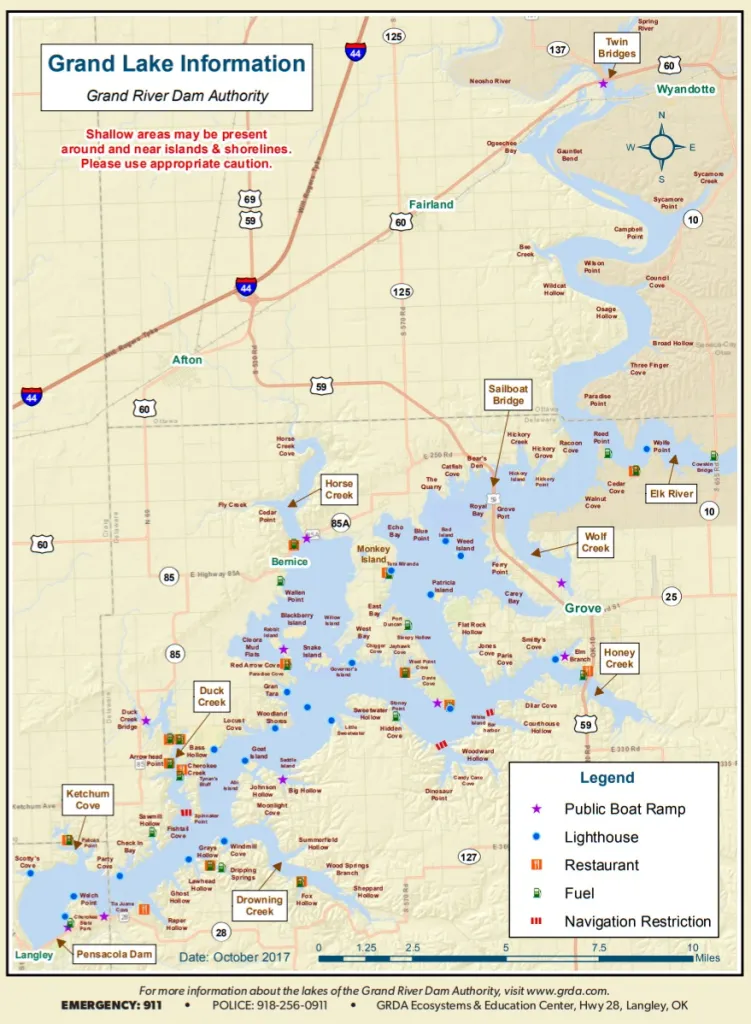
Grand Lake Navigation Map
Know the lake before you go. This GRDA map shows boat ramps, fuel locations, restaurants, and navigation restrictions across all 46,000 acres.
Click the map to view full size. Map courtesy of GRDA.
Boat Rentals
Don't own a boat? No problem. Grand Lake has several rental options including pontoons, tritoons, jet skis, ski boats, fishing boats, kayaks, and paddleboards.
Rental Tips
Book early — Boats get snapped up fast during peak summer season
Know the rules — Your rental company will brief you, but review the basics before you go
Ask questions — If you're unsure about operating a boat, the rental company is there to help
Safety first — Always wear a life jacket, watch the weather, and don't drink while driving
This is an ongoing tension at Grand Lake — wake boats, tube boats, and skiers creating wakes that damage docks, erode shorelines, and rock lakefront property owners' investments.
The rules are clear: You must be at idle speed within 150 feet of any structure, including docks.
The reality: Not everyone follows the rules, and bigger wakes from modern wake boats are harder on lakeside property than ever before.
For Boaters
Be aware of your wake. What feels like nothing from your driver's seat can be a 3-foot wave hitting a dock. Slow down near shorelines and structures — not just because it's the law, but because it's the right thing to do.
For Property Owners
Some wake impact is unavoidable on a popular public lake. That's part of lakefront ownership. Invest in quality dock construction and talk to your neighbors about reasonable expectations.
High Water and Debris
When heavy rains hit Northeast Oklahoma, the rivers flush debris into Grand Lake. Trees, branches, and all kinds of floating hazards become navigation risks.
Tips for Boating During High Water
Check your dock area and boat ramp for debris before launching
Designate a second person as a lookout
Avoid nighttime boating when debris is harder to spot
What looks like a small branch may be the top of a submerged tree
If you encounter a debris field, go around. If you must go through, slow down and trim your motor up.
Stay away from shorelines where submerged obstacles (signposts, picnic tables, stumps) may lurk
Important
Do NOT push debris that washes onto your shoreline back into the water. It's a GRDA violation and creates a navigation hazard.
Cold Weather Boating
Grand Lake is a year-round lake, but winter boating requires extra precautions:
Cell phone: Fewer boats on the water means fewer people to help if you have trouble
Whistle: Attach one to your life jacket. It uses less energy than shouting
Navigation lights: Check that they work. Days are shorter and darkness comes fast.
Hypothermia risk: Cold water robs body heat 25x faster than cold air. If you capsize, get as much of your body out of the water as possible.
File a float plan: Even more critical when there's less traffic on the lake
Early Morning: The Best Time on Grand Lake
Insider Tip
Sunrise is the best time to be on Grand Lake. The air is still, the water is glass, and you'll have the lake practically to yourself. For wakeboarding, skiing, or surfing, there's nothing like those glassy morning conditions. Your body will thank you too — no bouncing across boat wakes at 2 pm on a Saturday.
Get on the water early, early, early. By 10 am, the traffic picks up. By noon on a holiday weekend, it's chaos. But at 6:30 am? Pure zen.